|
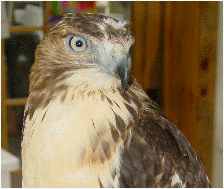
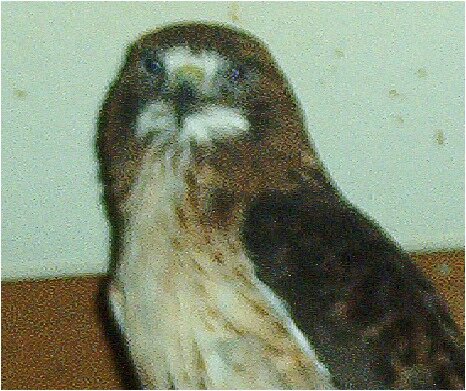
Lily Savannah Nelly Lily, Savannah and Nelly, all Red-Tailed Hawks, are resident birds at Barnswallow. Lily is imprinted and cannot be released--she now serves as an educational bird. Savannah sustained wing injuries as a juvenile, also making her release impossible. She too is an educational bird. Nelly lost an eye due to a collision with an automobile, and is now a foster mother, raising orphaned Red-Tailed hawks in the spring and summer.
|
Red-tailed Hawk (buteo jamaicensis) Large, conspicuous hawk, often seen perched along roadsides. Primary food mice, rabbits, other mammals. Identification: Broad wings and tail. Adults have characteristic red tail, while juveniles have brown tail. Breast mottled and streaked cream and brown, wings dark brown to reddish. Sexes alike. Nests primarily high in trees. Northern Illinois resident. Vocalization: A high, raspy scream, often heard while bird is in flight. Length: 19" Wingspan: 49" Weight: 2.4 lbs. |
|
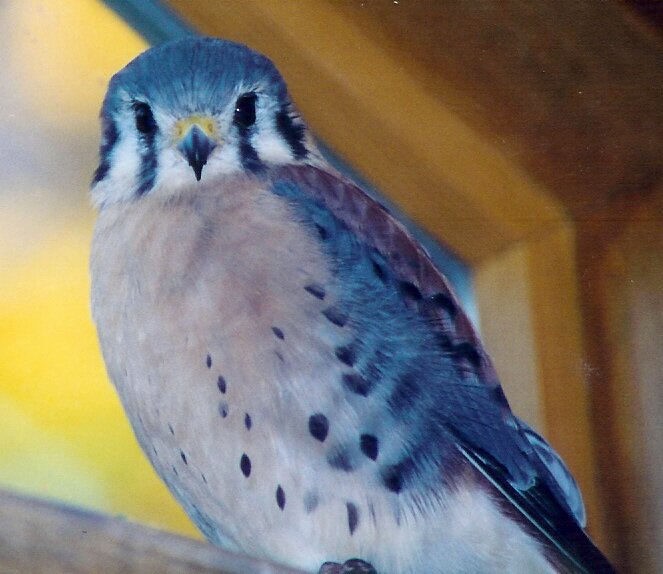
Carson, an American Kestrel, is an imprinted bird. He was raised by humans and thus identifies with humans rather than his own species. He is now an educational bird.
|
American Kestrel (falco sparverius) North America's smallest falcon. Frequently seen along roadsides, hovering or perched on telephone wires. Primary food mice, voles, insects. Identification: Long wings and tail. Male reddish brown with streaks of black on wings and tail. Female reddish brown with blue-gray wings. Tail brown with black tip. Nests in cavities. Northern Illinois resident. Vocalization: A rapid series of harsh 'kik-kik-kik' calls. Length: 9" Wingspan: 22" Weight: 4.1 ounces |
|
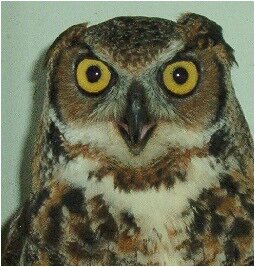
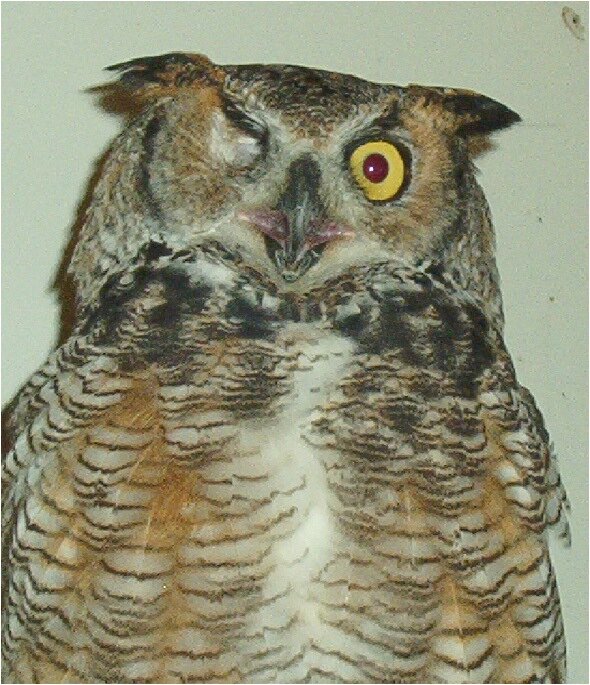
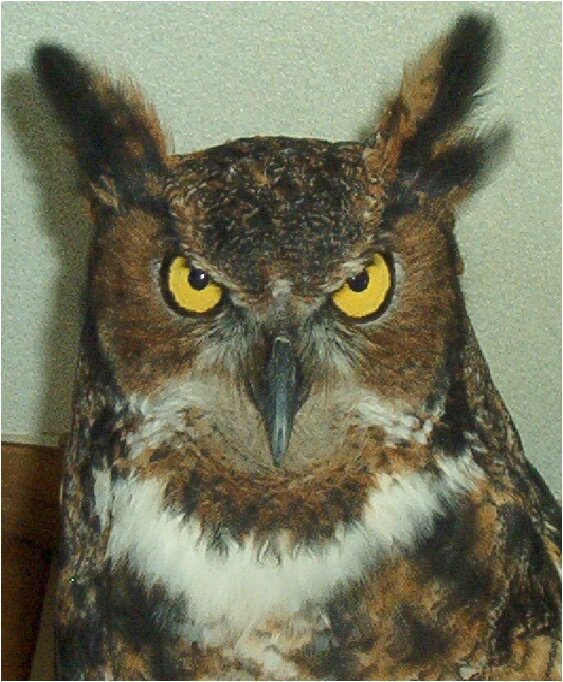
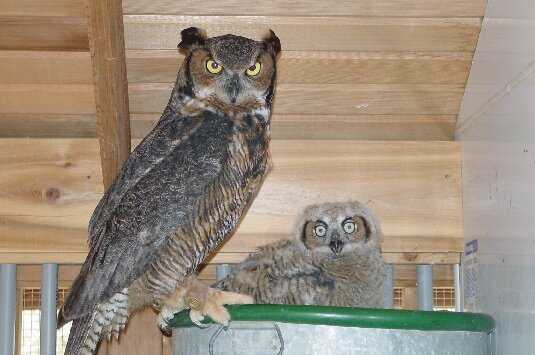
Lancelot Jack Emily Lancelot, Jack and Emily, are Barnswallow's resident Great Horned Owls, Lancelot sustained an injury to his wing, while Jack lost an eye after a collision with an automobile. They now are educational birds. Emily is an imprinted bird, and though in perfect health and appearance, cannot be released. She serves as a foster mother, spending spring and summer months raising orphaned Great Horned Owls.
Emily with juvenile Great Horned owl
|
Great Horned Owl (bubo viginianus) Most widespread owl in North America. Found in widely varied habitats, from county to city to suburbs, occurring wherever prey is available, Primary food rabbits, mice and other mammals. A crepuscular owl (most active at dawn and dusk). Does not build a nest of its own, but uses crow or hawk nests, dead trees, or sometimes man-made nest structures. Northern Illinois resident. Identification: Large, broad body and wings. Color variation in plumage common, varying from very pale, almost whitish wings, head and body to very dark brown. Eyes yellow. Sexes alike. Vocalization: A series of deep hoots, ranging in length and rhythm. Female voice tends to be higher than males. Juvenile begging call a raspy high-pitched screech. Length: 22" Wingspan: 44" Weight: 3.1 lbs. |
|
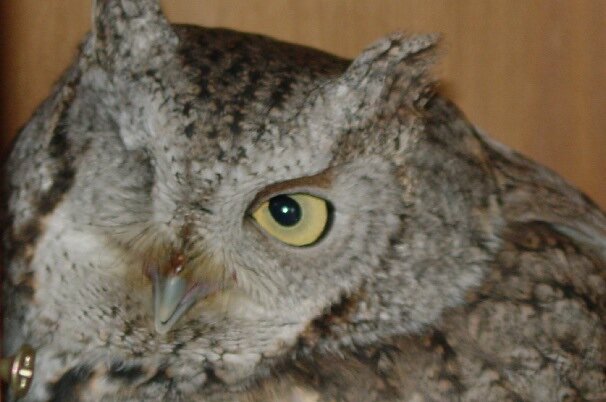
Zeus, a gray phase Eastern Screech owl, sustained an eye injury in a collision with an automobile. He serves as an educational bird as well as a foster parent to orphaned Screech Owls.
|
Eastern Screech-Owl (otus asio) Small owl, found in woods and forested areas. Primary food small rodents and insects. Eastern Screech-owl has two color phases, Red and Gray. Identification: Small but stocky bird with yellow eyes and pale greenish bill. Ear tufts as in Great Horned owl, most often used in camouflaging the bird while roosting. Underparts barred and streaked, upperparts mottled reddish-brown or gray, depending on color phase. Sexes alike. Nests in tree cavities, nest boxes. Northern Illinois resident. Vocalization: Two most common calls a soft trilling or a high, horselike whinny. Length: 8.5" Wingspan: 20" Weight: 6 ounces |
|
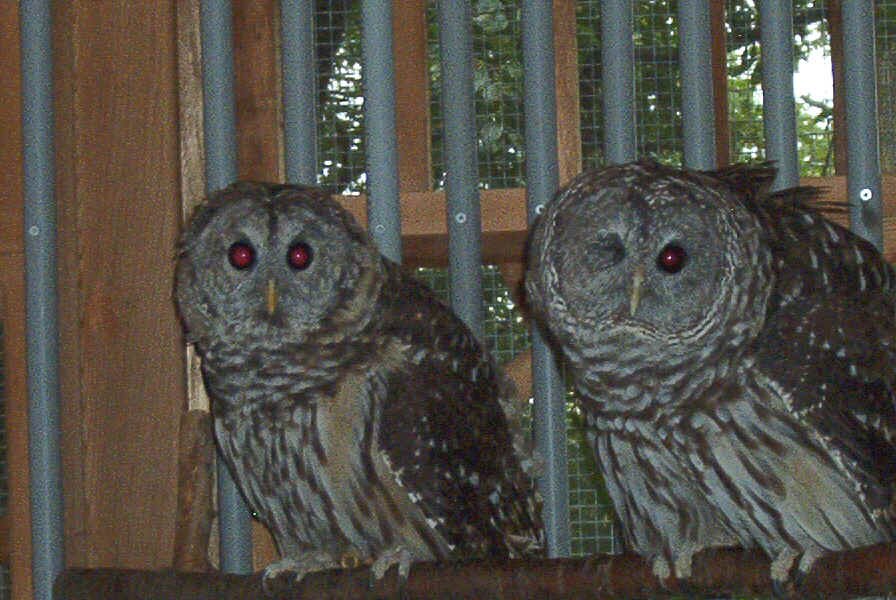
Nick and Griffin, resident educational Barred Owls at Barnswallow. Griffin has a wing injury and Nick lost an eye, both caused by collisions with automobiles.
|
Barred Owl (strix varia) Large, stocky round-headed owl. Found in riparian woodlands, hunting primarily rodents and small mammals. Northern Illinois s resident. Identification: Breast barred cream and brown., wings spotted and streaked brown and cream. Black eyes and yellow bill. Facial disks pronounced. No ear tufts. Vocalization: Barred owl has the most varied and unusual repertoire of the North American owls. Calls range from barking, screaming, monkey like yelling, to laughing, whispering and an expressive "who cooks for you, who cooks for you allllll" series of hoots. Length: 21" Wingspan: 42" Weight: 1.6 lbs. |
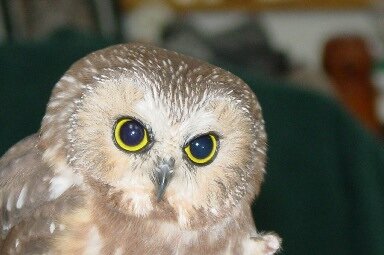
Boopie, Barnswallow's smallest resident, had part of her left wing amputated due to a collision with an automobile. She now resides at Barnswallow as an educational bird. |
Northern Saw-whet Owl (aegolius acadicus) Tiny, shy resident of deep woods and forests. Needs large expanses of land for hunting and nesting. Nests in tree cavities. Hunts small rodents, insects. No longer a resident of Illinois due to deforestation and development. Identification: Breast streaked brown and cream, wings brown with white spots. Eyes yellow. Plumage coloration mimics sun-dappled forest light and allows the bird to remain camouflaged. Vocalization: Soft, slow electronic sounding 'boops'. Also high screech and nasal barks, soft whistle. Length: 8" Wingspan: 17" Weight: 2.8 ounces |
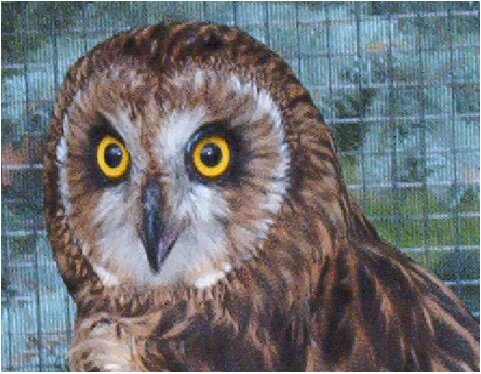
Miigwech, a Short-eared Owl, sustained a wing injury causing him to be unreleasable. He is an educational bird at Barnswallow. Miigwech is the Ojibwe word for 'thank you'
|
Short-eared Owl (asio flammeus) Long-winged, small ear tufted owl of open areas such as prairie, marsh and field. Frequently seen during the day quartering over land, low to the ground. Hunts small rodents. Nests on the ground. Northern Illinois residency depends upon hunting/nesting ground available. Identification: Long narrow wings in comparison to other owls. Pronounced facial disks and large head. Breast pale cream to light brown, streaked with darker brown. Wings barred and spotted with dark brown. Area around outside of eyes very dark brown. Ear tufts very short, frequently unnoticed. Eyes yellow, beak black. Vocalization: Unless during nesting season, this is a quiet bird. During mating/nesting, male calls in a muffled, 'boo-boo-boo' series. The relative silence may be attributed to the more diurnal habits of this bird. Length: 15" Wingspan: 38" Weight: 12 ounces
|
|
photo coming soon!!
Bear, A Long-eared owl, sustained a wing injury and is now a resident educational bird at Barnswallow. |
Long-eared Owl (asio otus) Long winged owl with a thinner, less chunky body than most. A hunter of rodents and small mammals, patrolling open areas. Takes the nests of crows and hawks, most frequently in coniferous trees. As with Short-eared Owl, Northern Illinois residency depends upon hunting/nesting habitat availability. Identification: Long narrow wings in comparison to other owls. breast streaked and mottled gray, brown and black. Wings gray with brown and black highlights. Pronounced facial disks and ear-tufts. Eyes yellow, beak black. Vocalization: A series of soft hoots at short intervals. Also nasal barks and mewing calls. Length: 15" Wingspan: 36" Weight: 9 ounces
|